Epitaxy and processing of NV diamond

Ultrapure synthetic diamond

Material production and optimization

Fraunhofer IAF offers customized synthetic diamond for various applications in quantum technology and other fields.

The ultrapure single-crystal and poly-crystalline diamond substrates and thin films are grown at the institute using chemical vapor deposition (CVD) in a homoepitaxial and heteroepitaxial manner and are specially tailored to quantum devices, electronic or photonic devices.

Creation of microstructures containing color centers as atomic scale sensors for quantum sensing Generation of NV centers as ensembles in layers for quantum sensing or few centers for spin qubits in quantum computing.

Fields of application

  • Quantum sensing for high-sensitive measurements in materials characterization, nanoelectronics, chemical analytics
  • Quantum computing with room-temperature quantum processors based on color centers in diamond
  • Micro- and nanoelectronic devices
  • Photonic devices

Advantages of synthetic diamond

Precise material defects in the form of so-called color centers in synthetic diamonds make it possible to manufacture components for quantum technologies, including individual quantum bits (qubits).

Due to the incredibly rigid structure of diamond, the quantum effects of color centers incorporated within the crystal can be observed and harnessed close to room temperature in contrast to, e.g., superconducting circuits that form the qubits in state-of-the-art quantum computers operating under cryogenic conditions. Diamond-based systems can be used even in close proximity to other electronics in hybrid systems and have fewer infrastructure requirements and lower operating costs.

Six square diamond tiles lie in a semicircle around a metal cylinder.
© Fraunhofer IAF
Fraunhofer IAF has long-standing expertise in the production of synthetic diamond and generates both very pure volume crystals and crystal layers of high structural quality.

Diamond properties

  • Refractive index: 2,4
  • Optical window: 300 nm to 2,5 µm and 7 to > 100 µm
  • Density: 3,51 g/cm3
  • Thermal conductivity: 2.600 W/mK
  • Hardness: 10.000 HV


PE-CVD homoepitaxy

  • N-doping and vacuum generation
  • Orientation and light extraction
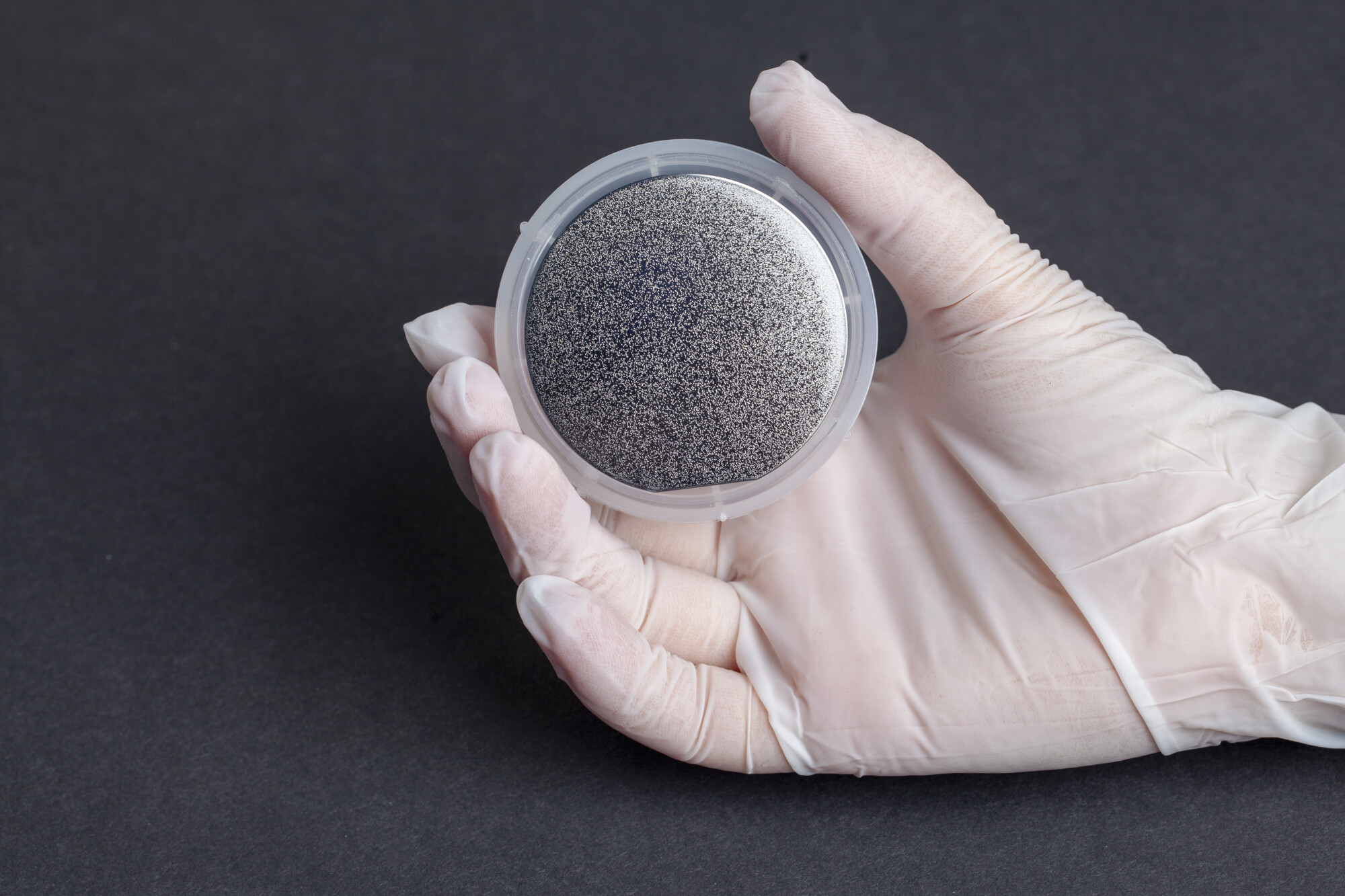
Hand in glove holding a diamond wafer
© Fraunhofer IAF
In order to make the unique material properties of diamond also industrially usable, high-quality diamond substrates are grown on wafer scale at Fraunhofer IAF for use in the fields of quantum sensing, quantum computing or power electronics.

Diamond synthesis equipment

For diamond synthesis, Fraunhofer IAF runs in total 10 microwave plasma reactors:

  • 7 reactors covering a 80 mm diameter area
  • 3 reactors covering a 150 mm diameter area

The reactors are equipped with purified gases to obtain contamination-free diamond and dopant gases as well as isotopically-enriched gases to alter the diamond properties or include color centers during growth.

Plasma reactor with an additional image from inside the reactor.
© Fraunhofer IAF
Close-up from inside the reactor shows seven diamond platelets surrounded by violet light.
© Fraunhofer IAF
Close-up of a glass dome belonging to a diamond reactor.
© Fraunhofer IAF

Processing

For further customized processing of synthetic diamond, Fraunhofer IAF offers different technologies for the structuring of wafers and diamond crystals:
  • Diamant-Chiptechnologie
  • Elektronenstrahllithographie​
  • Laserlithographie/-schneiden​
  • Reaktives Ionen-Ätzen​
  • Metallisierung​
  • Polieren

Doping of diamond

Fraunhofer IAF provides different dopants for diamond, each tailored to their application:

  • Nitrogen for nitrogen vacancy (NV) generation
  • Boron for p-type diamond
  • Phosphorous for n-type diamond

Further information

Quantum computing at Fraunhofer IAF

Fraunhofer IAF pursues different approaches in order to realize quantum computing hardware and software.

Quantum Sensing at Fraunhofer IAF

Find more information about our R&D activities in the field of quantum sensing.

Scientific publications


Get to know our latest research results.