 Fraunhofer Institute for Applied Solid State Physics IAF
The new weather satellites in the MetOp-SG series, developed by ESA and operated by EUMETSAT, are expected to deliver more accurate weather forecasts and climate analyses than ever before. On August 13, 2025, the first of six satellites was successfully launched into polar orbit by the European Ariane-6 launch vehicle. The instruments on board include a passive microwave radiometer for measuring temperature and humidity in the atmosphere. It contains 22 low-noise amplifier chips from Fraunhofer IAF.

The MetOp-SG series of weather satellites are expected to enable significantly better weather forecasts and climate analyses over the next 20 years
© ESA/ATG medialab
European weather satellite MetOp-SG-A1 uses Fraunhofer IAF LNA chips
08/15/2025 / MetOp-SG mission aims to improve weather and climate monitoring
On August 13, 2025, the European launch vehicle Ariane-6 launched the first of a total of six MetOp-SG weather satellites into polar orbit at an altitude of 832 km. The mission aims to significantly improve European capabilities in weather and climate monitoring. To this end, three successive pairs of satellites (MetOp-SG-A1 to MetOp-SG-B3), each equipped with complementary measuring instruments, will collect more accurate data than previously possible for global weather forecasts and climate analyses over a period of approximately 20 years.
The European Organization for the Exploitation of Meteorological Satellites (EUMETSAT) in Darmstadt, Germany, is in charge of the MetOp-SG satellites’ operation. The European Space Research and Technology Center (ESTEC) of the European Space Agency (ESA) in Noordwijk, Netherlands, is responsible for the development and commissioning of the satellites.

The MetOp-SG series of weather satellites are expected to enable significantly better weather forecasts and climate analyses over the next 20 years

The passive microwave sounder (MWS) of the MetOp-SG-A contains a total of 22 mHEMT LNA chips from Fraunhofer IAF
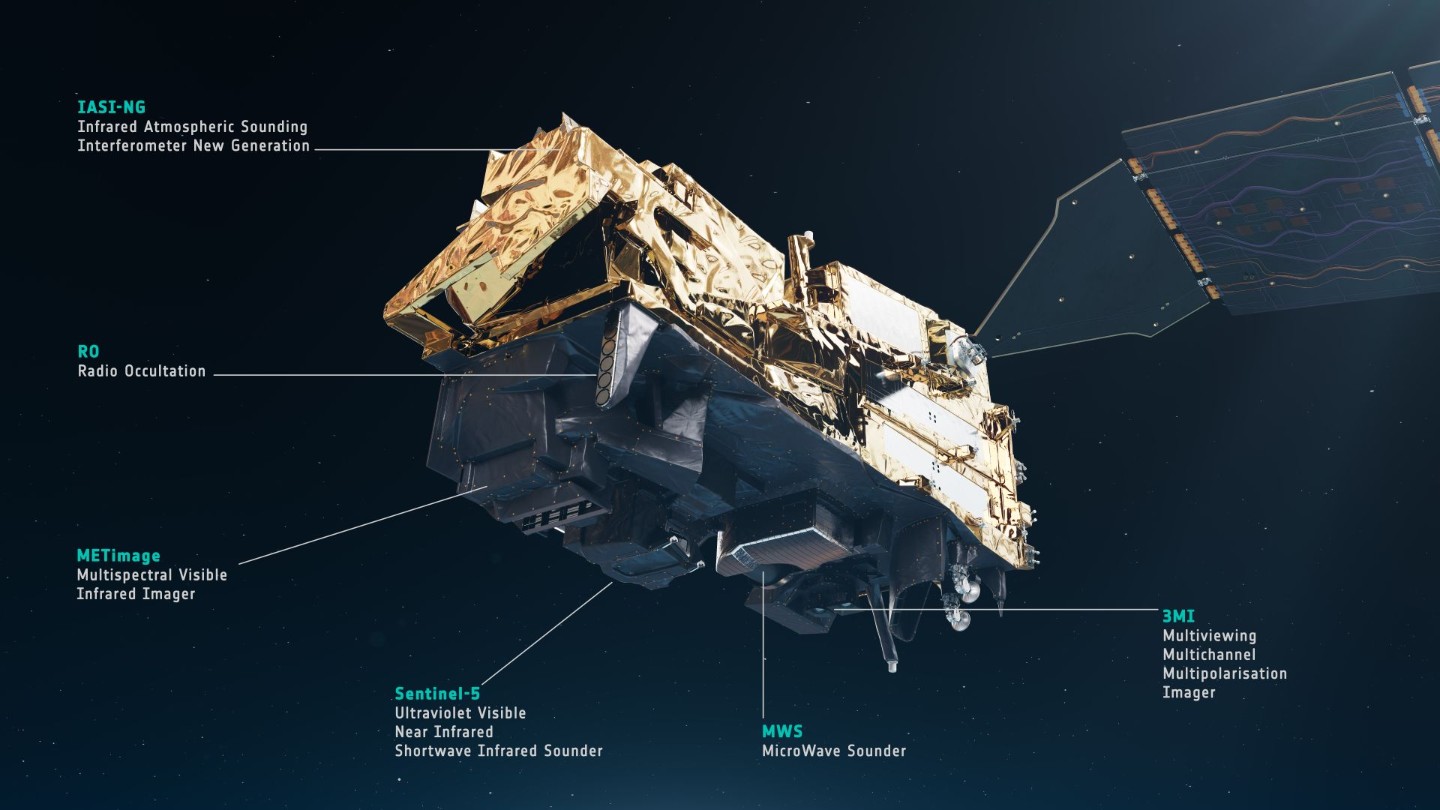
Overview of the six different measuring instruments of the MetOp-SG type A
MetOp-SG-A1 instruments
The MetOp-SG satellites orbit the Earth in polar orbit, covering the entire globe within 24 hours. The satellites weigh just over 4 tons each and have a service life of 7.5 years before being replaced by their successors. They carry an active disposal system that allows the satellites to self-destruct in the Earth’s atmosphere at the end of their service life.
The MetOp-SG-A1’s payload includes six different instruments: a new-generation infrared atmospheric sounding interferometer (IASI-NG), a meteorological imager (METimage), a multiviewing, multichannel, multipolarization imager (3MI), a radio occultation sounder (RO), the spectrometer for the Copernicus Sentinel-5 mission, and a passive cross-track microwave sounder (MWS).
Fraunhofer IAF provides mHEMT LNA chips
The latter contains low-noise amplifier (LNA) chips developed and manufactured at Fraunhofer IAF. The MWS detects the Earth’s natural microwave radiation and uses the collected data to create temperature and humidity profiles of the atmosphere. Since the microwave radiation is very weak, the signals must be amplified. This task is performed by the LNAs. The lower the noise of the amplifiers, the more sensitive the MWS detector works.
The MWS detects microwave radiation on 24 different frequency channels between 24 and 229 GHz. The Fraunhofer IAF LNA chips are used in the 22 channels around 54, 89, 165, 183, and 229 GHz. The LNA chips have been developed since 2011 as part of the PRERALNA and PRERALNA2 projects. They are based on metamorphic high-electron-mobility transistors (mHEMT) in an indium gallium arsenide (InGaAs) material system. Industrial partners commissioned by ESA assembled, integrated and qualified the Fraunhofer IAF LNA chips.
Launch of MetOp-SG-B1
The launch of the first complementary satellite, MetOp-SG-B1, is planned for 2026. It will feature a scatterometer (SCA), another radio occultation sounder (RO), a novel microwave imager (MWI), a novel ice cloud imager (ICI), and the advanced data collection system (ADCS) Argos-4. LNA chips from Fraunhofer IAF will also be installed in the MWI and ICI.