 Fraunhofer Institute for Applied Solid State Physics IAF
On July 17, 2025, the partners of the NeuroQ lighthouse project met at the University of Stuttgart for a mid-term meeting. With the successful presentation of their milestones to date, they confirmed the progress made so far and laid the foundation for the second phase of the project.

© Universität Stuttgart
Quantum Sensing for Medicine: NeuroQ Project enters the second half
07/30/2025 / Funding secured by the Federal Ministry of Research, Technology and Space
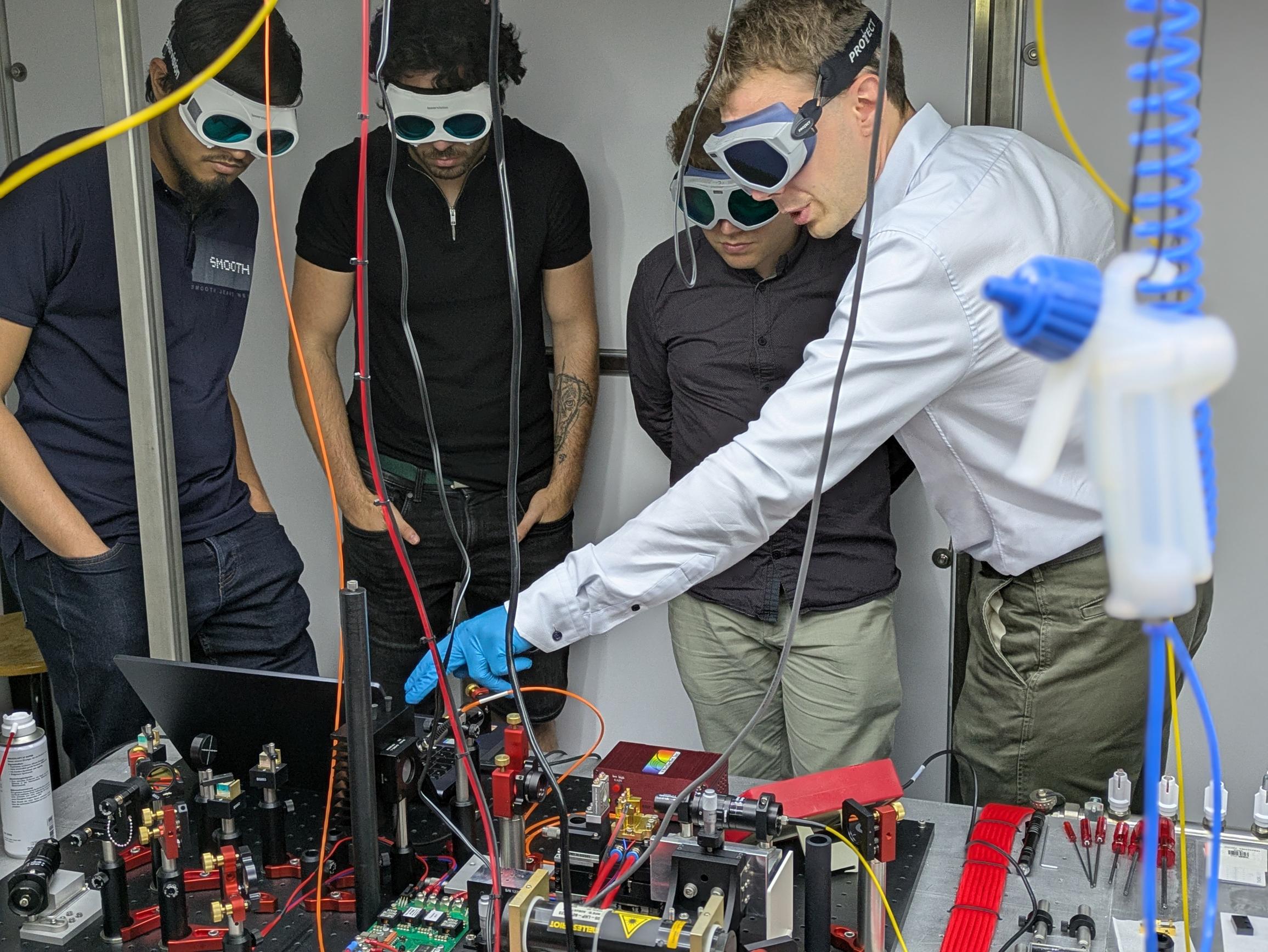
The aim of the project is to develop diamond-based quantum sensors for non-invasive medical applications, in particular for mind-controlled of exoskeletons. This innovative interface between brain activity and the musculoskeletal system is intended to help people regain their mobility after neurological events such as strokes.
"The milestones we have achieved motivate us to continue working towards our central goal in the second phase of the project: to demonstrate the enormous potential of diamond-based quantum sensing for direct application to patients," emphasizes Dr. Jan Jeske, project manager of NeuroQ and quantum sensing researcher at Fraunhofer IAF.
Advancements in Quantum Sensing and Initial Test Measurements
During the meeting, the project partners presented significant progress. Improved components for the new diamond-based quantum sensors, such as new laser media at suitable wavelengths, adapted electronics and improved pump lasers were researched. The diamond-based quantum sensors themselves were further developed into a novel diamond-based laser system, which significantly improved the contrast of the sensor signals – a central aspect for precise neuronal measurements. In addition, it was possible to successfully connect the sensor technology to an exoskeleton system. Initial tests for the acquisition of human signals were also carried out. In addition, a shielded reference environment was set up, which is now available for upcoming validation and application tests.
The NeuroQ consortium brings together leading research institutions and companies from quantum technology and (medical) technology: Fraunhofer IAF, University of Stuttgart, Charité – Universitätsmedizin Berlin, as well as the companies Twenty-One Semiconductors, Advanced Quantum, Sacher Lasertechnik, W+R Schirmungstechnik, neuroConn and NIRx Medizintechnik. The joint project, launched in 2022, is funded as part of the BMFTR initiative "Lighthouse projects in quantum-based metrology to address societal challenges."
Important recent publications
- Florian Schall, Felix A. Hahl, Lukas Lindner, Xavier Vidal, Tingpeng Luo, Alexander M. Zaitsev, Takeshi Ohshima, Jan Jeske, and Rüdiger Quay, "High-contrast absorption magnetometry in the visible to near-infrared range with nitrogen-vacancy ensembles," Opt. Express 33, 10899-10910 (2025). DOI: 10.1364/OE.550716
- Lukas Lindner et al. “Dual-media laser system: Nitrogen vacancy diamond and red semiconductor laser,“ Science Advances 10, eadj3933 (2024) DOI: 10.1126/sciadv.adj3933
- Benke, Magnus & Zhang, Jixing & Kübler, Michael & Anders, Jens, “Optimising Quantum Sensor Components,” 273-275 (2024). DOI: 10.1109/MEMS58180.2024.10439317
- Zhang C, Zhang J, Widmann M, Benke M, Kübler M, Dasari D, Klotz T, Gizzi L, Röhrle O, Brenner P, Wrachtrup J, “Optimizing NV magnetometry for Magnetoneurography and Magnetomyography applications,” Front Neurosci. 2023 Jan 12;16:1034391. DOI: 10.3389/fnins.2022.1034391
- Sarath Raman Nair, Felix A. Hahl, Andrew D. Greentree, Jan Jeske, Thomas Volz, “Chapter 12 - Diamond laser threshold magnetometer,” Editor(s): Mario Agio, Stefania Castelletto, In Nanophotonics, “Nanophotonics with Diamond and Silicon Carbide for Quantum Technologies,” Elsevier, 2025, Pages 219-228. DOI: 10.1016/B978-0-443-13717-4.00012-8.
Submitted publications
- Rottstaedt, Yves & Lindner, Lukas & Schall, Florian & Hahl, Felix & Luo, Tingpeng & Reiter, Florentin & Ohshima, Takeshi & Zaitsev, Alexander & Bek, Roman & Rattunde, Marcel & Jeske, Jan & Quay, Rüdiger, “Two-media laser threshold magnetometry: A magnetic-field-dependent laser threshold,” (2025). DOI: 10.48550/arXiv.2504.08466
- Zhang, Jixing & Kuebler, Michael & Cheung, Cheuk & Benke, Magnus & Denisenko, Andrej & Anders, Jens & Corcione, Emilio & Sauer, Cristina & Isoya, Junichi & Zhang, Chen, “Blueprint for NV center ensemble based magnetometer: precise diamond sensor material characterization,” (2024). DOI: 10.48550/arXiv.2408.14318