SmaraQ — Integrated Photonics With Aluminum Nitride and Oxide for Ion-Trap-Based Quantum Computing

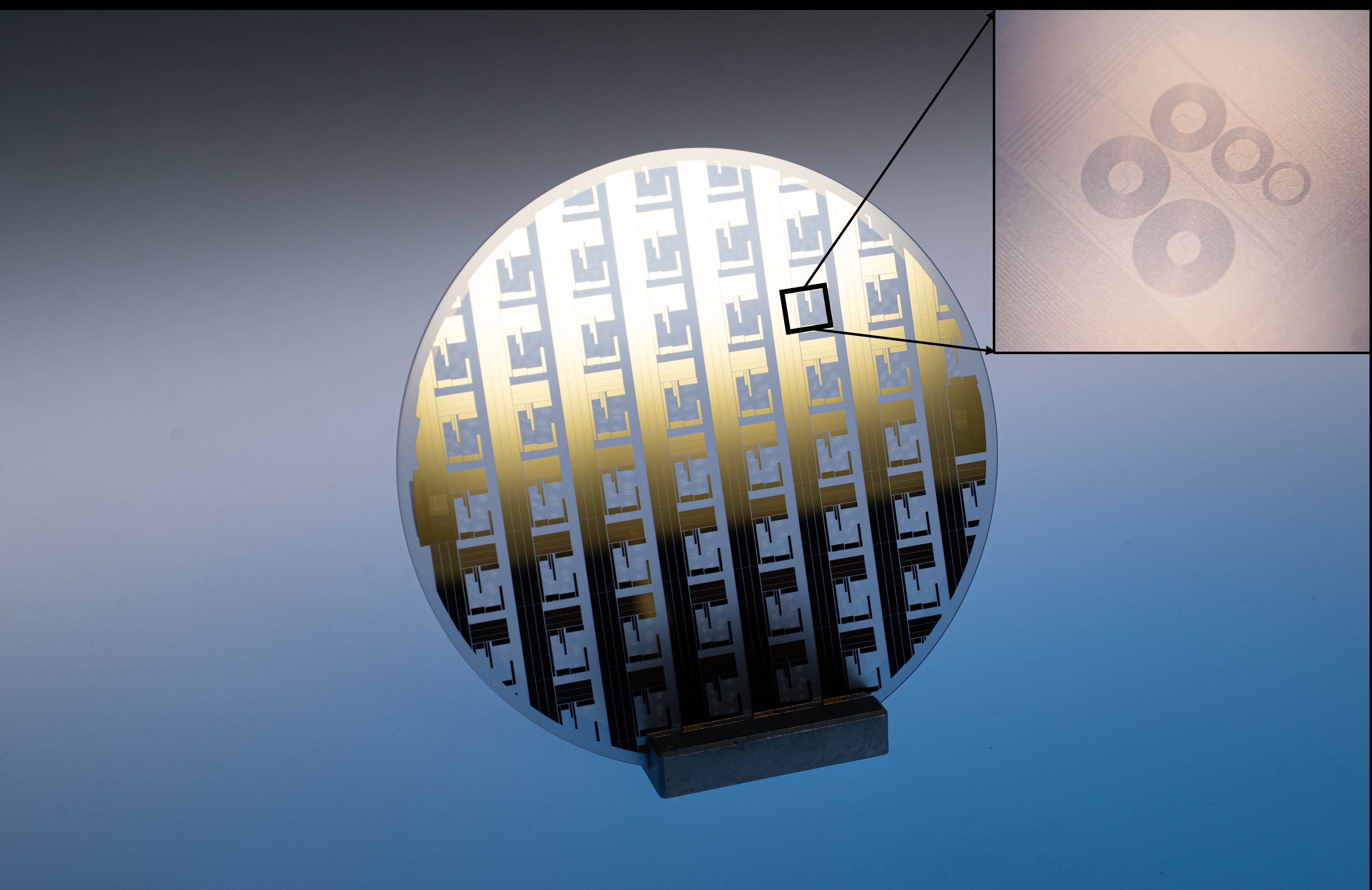
Processed wafer with an insert showing circular structures.
© Fraunhofer IAF
AlN waveguides on a 4-inch sapphire wafer for trapping ions in ion-trap-based quantum computers. Inset: Spiral waveguides for the measurement of optical loss.

Quantum computers based on ion trap technology offer excellent scalability and qubit quality, as the naturally identical ions are electrically fixed at defined positions on the chip by electrodes. The SmaraQ project is developing UV waveguides and photonic components for ion trap chips to enable robust, scalable quantum computers that meet the stringent requirements for error-free quantum operations for real-world applications.

Through chip integration, SmaraQ enables the miniaturization and scaling of ion trap quantum computers, which is not possible with cabinet-filling free-beam optics. A photonic solution in the UV range with polarization control represents a breakthrough for quantum computing, but can also be used, for example, for sensor technology or novel means of communication (augmented/virtual reality).

PROJECT TITLE

SmaraQ — Integrated Photonics With Aluminum Nitride and Oxide for Ion-Trap-Based Quantum Computing


DURATION

2025–2028

FUNDING

Federal Ministry of Research, Technology, and Space BMFTR

COORDINATOR

QUDORA Technologies GmbH (coordination)

OBJECTIVES

  • Realization of UV waveguides and photonic components for ion trap chips based on AlN and AlO
  • Optimization of photonic components with regard to polarization purity
  • Development of a demonstrator for ion trap quantum computing 

Further information

Quantum Computing at Fraunhofer IAF


Get more information about our activities in the field of quantum computing.


Optoelectronics at Fraunhofer IAF

Learn more about our R&D activities in the fields of semiconductor lasers and photodetectors.